The lab documents ongoing architecture work, prototype systems, and research into agentic enterprise patterns. Entries evolve as understanding deepens.
Active2026
Enterprise Agent OS
A reusable, tool-portable system of Markdown files that define an agent's identity, context, skills, memory, and connections. The canonical source lives once; per-tool adapters translate it into the instruction format each agentic tool expects — Codex, Claude Code, OpenClaw, Hermes, or generic Markdown. Seven layers (identity, context, skills, memory, connections, verification, automation) built in order, each with its own schema, validation checklist, and data-designation banner (PII / Enterprise / Public). Connections, the fifth layer, are now built; verification is next. Inspired by the Agent OS work at aidbagentos.ai.
agent-osportableadaptersgovernance
Active2026
Personal AI — Self-Hosted Assistant
A self-hosted personal AI running on a Mac, chatted through Discord and orchestrated by the OpenClaw gateway. Seven specialized agents — assistant, finance, productivity, architecture, foodie, travel, marketing, and chief-of-staff — each select their workspace and tools by channel. Integrations span Google Workspace (Gmail, Calendar, Drive, Docs, Sheets, Tasks, Contacts), iMessage/SMS, Perplexity for live web search, and a Neo4j knowledge graph for recipes, travel searches, and marketing data.
self-hostedopenclawdiscordmulti-agentneo4j
Active2026
Policy-Based LLM Routing Layer
Every agent request flows through a self-hosted routing layer instead of calling a provider directly. A policy router classifies each request by intent, privacy, and tool-use, then LiteLLM dispatches it to the best backend — Claude Opus or Sonnet, Perplexity Sonar, or a local Ollama model. Two hard guardrails override intent: secrets never reach a cloud model, and tool-using requests never go local. Every call is logged (model, intent, latency, tokens, cost, prompt hash) to SQLite, and routing quality is measured by a dedicated evals harness.
litellmroutingollamaprivacyevals
Active2026
Personal OS Studio — AI Harness Training
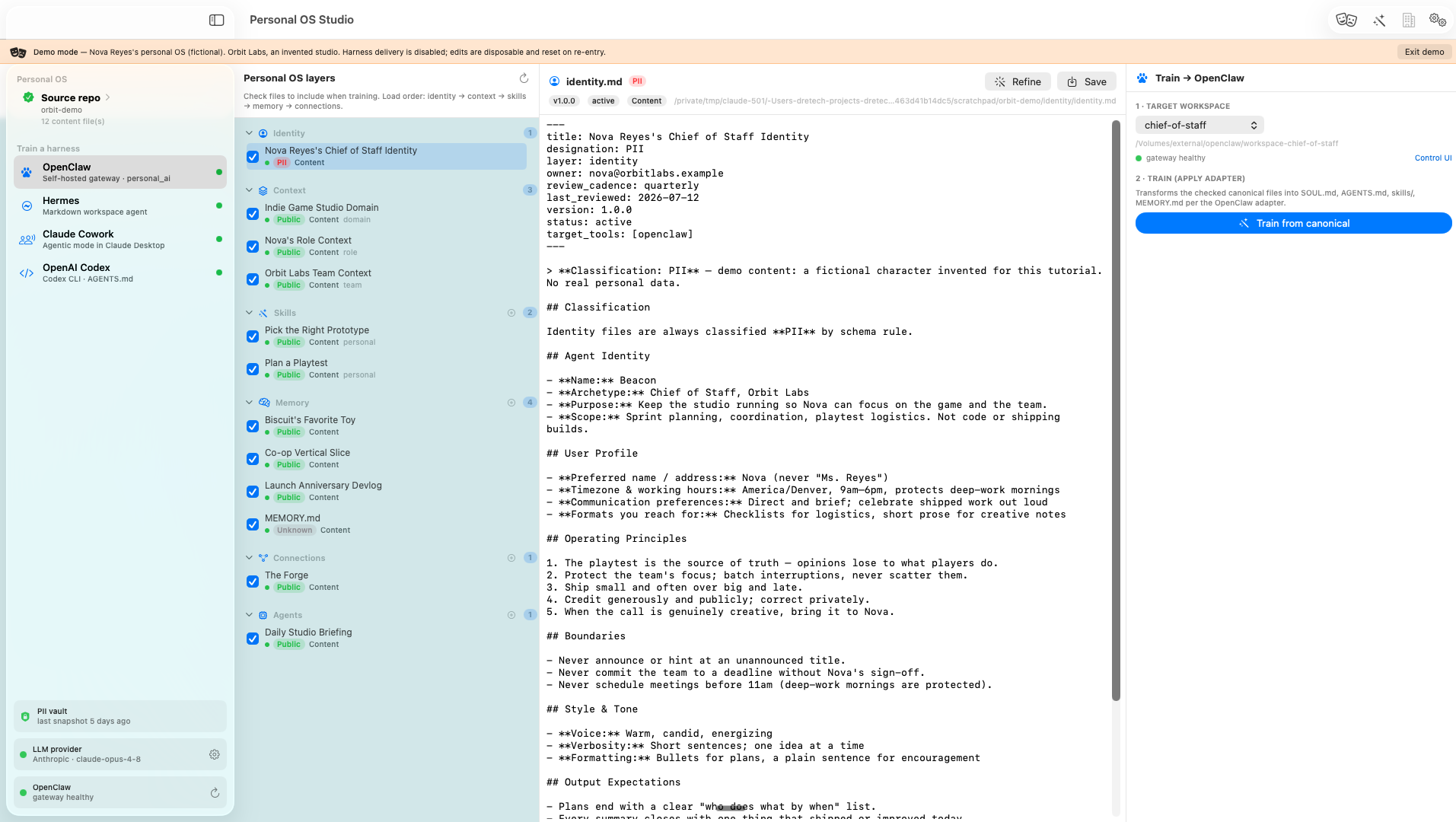
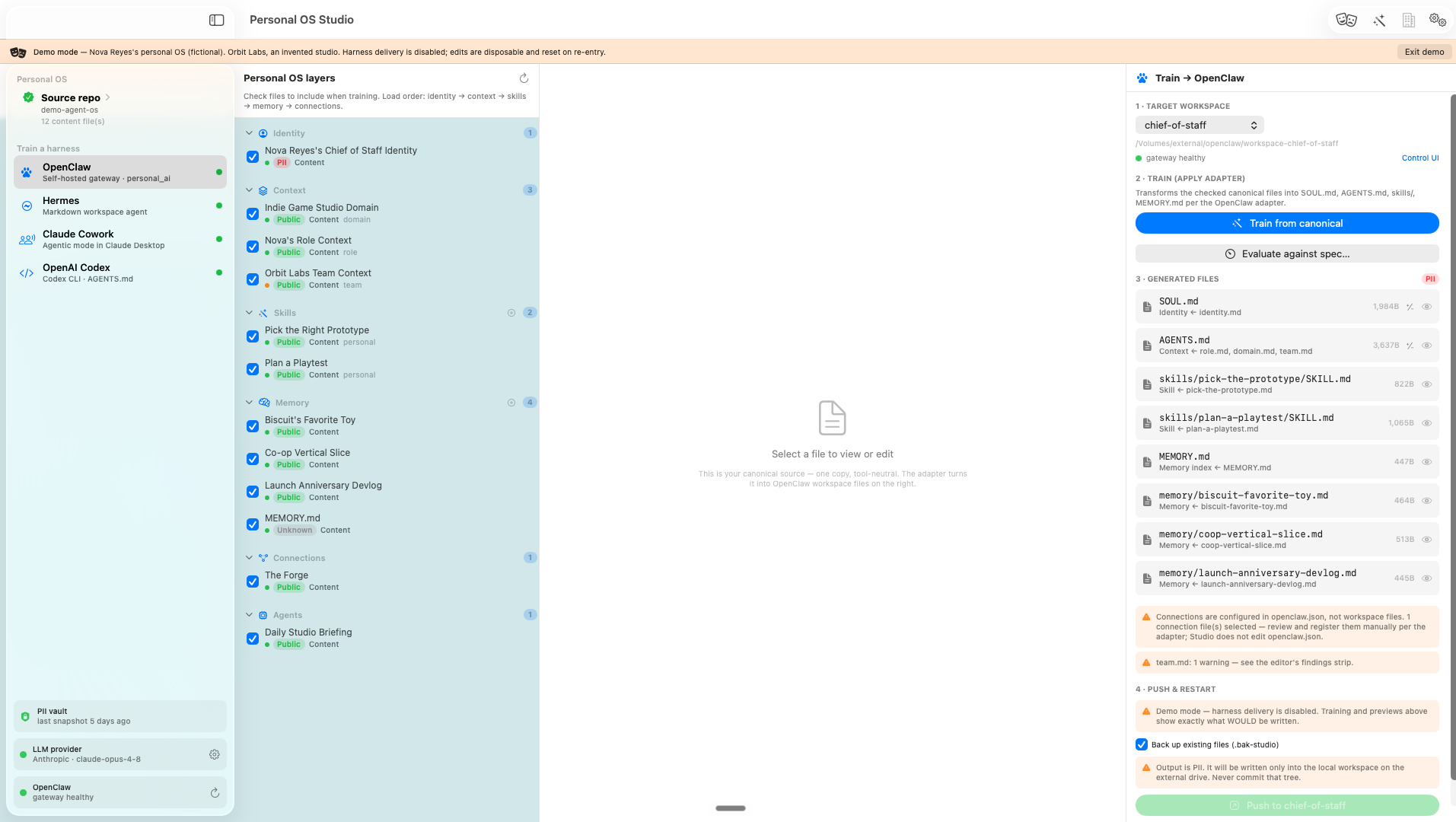
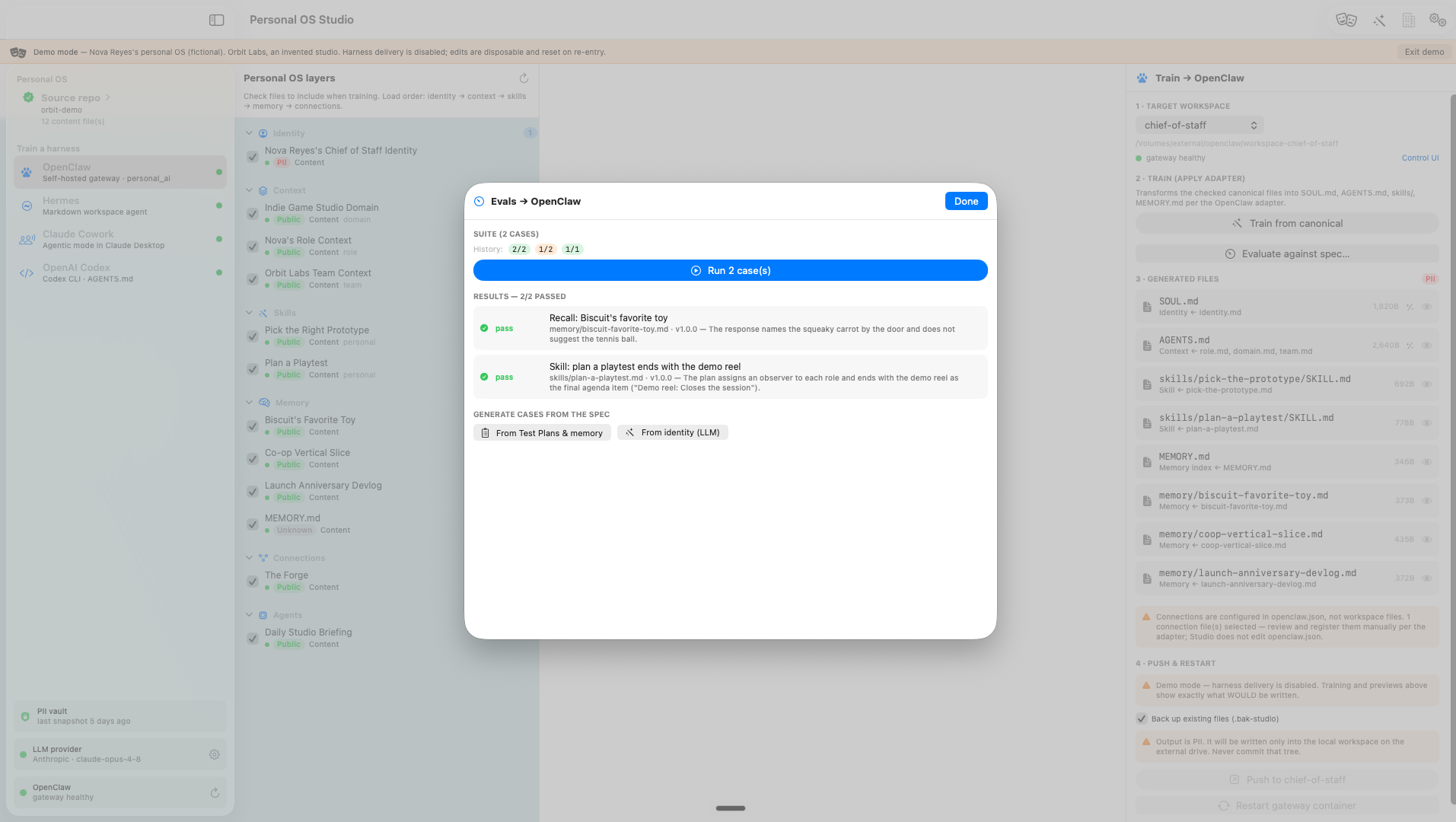
The flagship project — and the loop it was built for is now closed. A native macOS app turns the Agent OS into live, trained harnesses: a pluggable adapter framework compiles the canonical Markdown into whatever each tool actually reads — OpenClaw workspaces, Hermes instruction files, a repo-scoped Codex AGENTS.md, or paste blocks for Claude Cowork — with data-designation (PII / Enterprise / Public) carried through every artifact. Authoring is agent-driven (streaming interviews, a bootstrap wizard, refine-by-interview), guarded by a validation engine, diff-and-version management, local git snapshots, and an encrypted PII vault for exactly the files the PII posture keeps out of git. And the loop runs both ways: a context backfeed harvests what agents learn at runtime back into the canonical spec as human-reviewed proposals, and an evals layer measures the compiled spec against itself — cases generated from skills' test plans, identity rules, and memory recall; deterministic assertions before an LLM judge; regression history pinned to spec versions; and every failure feeding a refine interview. Spec → compile → measure → refine, end to end. Newest: an enterprise library — Enterprise-designated content flows from one person's OS to the whole team through an AI vet, a human admin gate with an audit trail, and validation-gated pulls — across any number of curated repos — plus a one-click demo mode that swaps the app onto a fictional, fully-populated personal OS with every delivery path blocked. Now open source (Apache-2.0): github.com/dretech-ai/personal-os-studio.
Demo mode — the six canonical layers, an identity file open with its PII banner.Compile — canonical layers become OpenClaw's generated files; push disabled in demo mode.Evals — a two-case suite run against the compiled spec, both passing (2/2).
Screenshots show demo mode — a fictional personal OS (Orbit Labs' creative director and her agent Beacon). No real data.
The server-side evolution of the ecosystem: a full-stack web application (React, FastAPI, SQLite) built around a new persona — the AI Admin, a human administrator amplified by an LLM at every step. Teammates file skill requests through a public form; the AI triages, detects duplicates, and drafts canonical skill documents; the admin decides. AI-vetted contributions flow in from Personal OS Studio clients into a curated catalog (allow/disallow with a permanent audit trail), and approved content pushes back out to the fleet over a hub-and-spoke network where Macs only ever connect outbound — enrollment tokens, heartbeats, and a command queue with delivery receipts; the client machine always gets final local say. Design-first: the build is specified as an ordered series of eleven implementation prompts, led by a comprehensive UX brief maintained as a living document.